Physical Address
304 North Cardinal St.
Dorchester Center, MA 02124
Physical Address
304 North Cardinal St.
Dorchester Center, MA 02124


This beginner fitness guide is not a motivational article, a list of random exercises, or a 30‑day challenge. It is a foundational training system designed to teach your body how to adapt to exercise safely, efficiently, and permanently.
Most people fail at fitness not because they lack effort, but because they start with the wrong structure. Beginners are biologically different from intermediate and advanced trainees, and they must be trained differently. This guide explains why that matters, how your body adapts in the beginner phase, and exactly how to train so you build results that last.
A beginner is not defined by age, weight, or the time spent in the gym. A beginner can be defined by how their body responds to training stress.
You are a beginner if:
This phase typically lasts 3–6 months of consistent training, but it can last longer if training has been inconsistent or poorly structured.
Understanding this matters because beginners experience a unique adaptation window that never fully returns later.
In the beginner phase, most strength gains come from neurological adaptations, not muscle size.
These include:
This is why beginners often get stronger before they look different.
If this phase is wasted with random workouts, excessive soreness, or injury, long‑term progress is permanently limited. The goal of beginner training is skill acquisition first, muscle second.
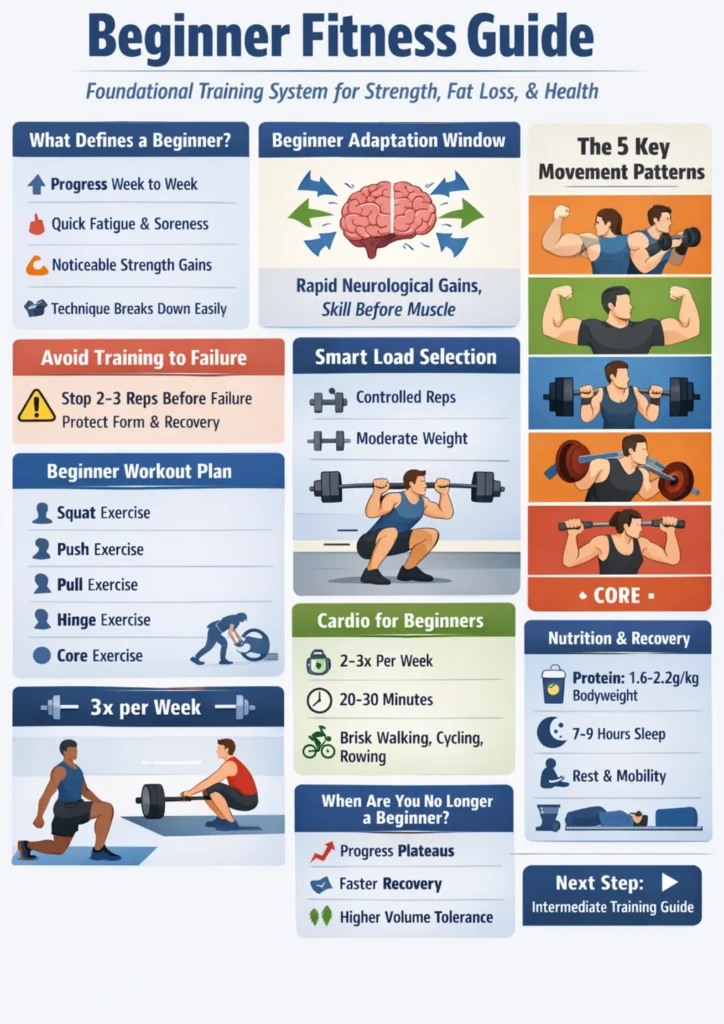
This progression gives beginners a clear starting structure while keeping loads conservative and technique-focused. The goal is consistency, not exhaustion.
Train three days per week using the same workout template. Increase effort gradually and only when form remains clean.
| Week | Training Focus | Load Strategy | Volume | What to Prioritize |
| Week 1 | Learn technique | Light to moderate | Standard | Control, posture, breathing |
| Week 2 | Build consistency | +2–5% load if clean | Same | Smooth reps, stable joints |
| Week 3 | Improve tolerance | Same load | +1 set on main lifts | Endurance and confidence |
| Week 4 | Solidify mastery | Small increase if ready | Same | Perfect reps, minimal fatigue |
Important rules:
This approach builds momentum without overwhelming recovery.
Beginners should not think in terms of exercises. They should think in movement patterns.
Every effective beginner program must include these five:
This builds knee and hip coordination, leg strength, and posture.
Examples:
Key focus: controlled depth, upright posture, stable knees.
This develops the posterior chain and protects the lower back.
Examples:
Key focus: pushing hips back, neutral spine, hamstring engagement.
This builds upper-body strength and shoulder stability.
Examples:
Key focus: ribs down, elbows controlled, shoulder stability.
This balances posture and strengthens the upper back.
Examples:
Key focus: shoulder blade control, smooth tempo, no jerking.
This protects the spine and improves force transfer.
Examples:
Key focus: breathing control, spinal stability, and tension management.
If a beginner program lacks any of these patterns, it is incomplete.
Warm-ups and cool-downs don’t need to be complicated. They just need to prepare the body and promote recovery.
The goal is to raise body temperature, lubricate joints, and activate the muscles you’re about to use.
Example warm-up:
Your warm-up should resemble the workout, just lighter and slower.
The goal is to bring the nervous system down and reduce stiffness.
This improves recovery and keeps joints feeling healthy.
One of the most damaging beginner mistakes is training every set to failure.
Training to failure:
Beginners benefit most from stopping sets with 2–3 reps in reserve (RIR). This allows frequent practice of correct movement without excessive fatigue.
More fatigue does not equal more progress at this stage.
Load selection is a skill. Most beginners guess. That leads to loads that are either too light to stimulate progress or too heavy to maintain technique.
A good beginner load should:
If every rep feels easy, the load is too light.
If the technique breaks down before the target reps, the load is too heavy.
Avoid training to failure. It increases nervous system fatigue, slows learning, and extends recovery time without improving beginner results.
Beginners recover more slowly from volume than from intensity.
This structure maximizes learning while minimizing soreness and burnout.
This template can be used at home or in a gym.
Do not change exercises weekly. Consistency builds mastery.
Cardio should improve health and recovery, not compete with strength training.
If cardio interferes with strength recovery, reduce it.
Nutrition for beginners should be simple and sustainable.
Protein supports muscle repair and satiety.
Aim for roughly 1.6-2.2 g per kg of bodyweight.
Avoid aggressive dieting during the beginner phase; it limits adaptation.
Progress does not happen during workouts. It happens during recovery.
Non‑negotiables:
Persistent soreness is a sign of excessive volume, not effectiveness.
Technology can help beginners learn faster if used wisely.
Tech should simplify training, not distract from it.
Avoiding these mistakes is often enough to double results.
You are ready to progress when:
This transition should be intentional, not accidental.
This page is the foundation of a larger fitness framework:
Once consistency and movement quality are established, the next step is structured intermediate programming.
Most beginners see the best results training three days per week with full-body workouts. This provides enough stimulus to build strength and burn fat while allowing proper recovery between sessions. Training more often usually increases soreness and fatigue without accelerating progress. On non-training days, light activity like walking or mobility work supports recovery and overall health.
Most beginners notice strength improvements within 2–3 weeks and visible body changes within 6–12 weeks, depending on consistency, nutrition, sleep, and starting fitness level. Early progress comes mainly from improved coordination and nervous system adaptation, not muscle size. Staying consistent with a simple program produces better long-term results than switching routines frequently.
Beginners should start with weights that allow perfect technique and leave 2–3 reps in reserve. Gradually increasing load builds strength safely while reinforcing proper movement patterns.